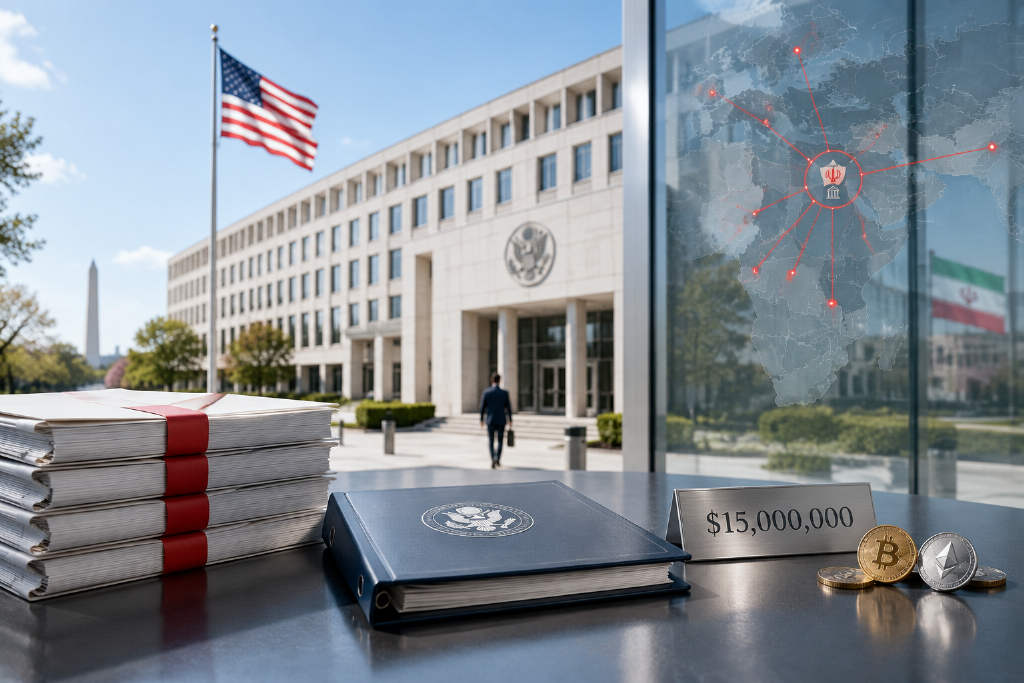
U.S. State De2026-09-29 23:18:43U.S. State Department offers up to $15 million for information on IRGC financial networkThe U.S. State Department has announced a reward of up to $15 million for information that could help disrupt the financial network of Iran’s Islamic Revolutionary Guard Corps, or IRGC. According to the brief carried by Techub News and attributed to Crypto Briefing, the move is aimed at tightening scrutiny of the network and increasing pressure on the cryptocurrency market to strengthen compliance measures. The stated goal is to curb sanctions evasion. The report did not provide additional operational details, but it framed the reward as part of a broader effort tied to financial oversight and enforcement pressure around crypto-related compliance.200
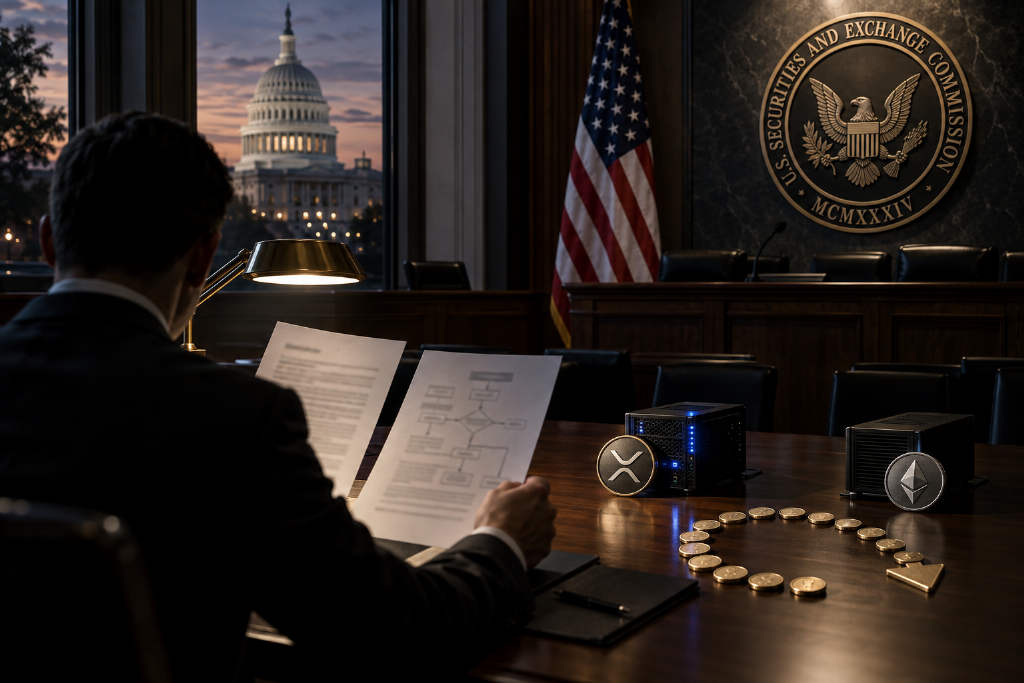
SEC2026-09-28 06:00:58SEC FAQ narrows the reading on token buybacks and network upgradesA new FAQ issued by the U.S. Securities and Exchange Commission’s Division of Corporation Finance on Sept. 25 has been widely read as a green light for token buybacks and continued post-launch development. The source article argues that reading goes too far. The FAQ is staff guidance, not a Commission rule, statement, or regulation, and it does not carry independent legal force. Instead, it gives more specific answers within the lifecycle framework the SEC Commission described in March 2026. The key question, the article says, is no longer whether a token is abstractly a security. The focus is whether the asset remains tied to promises made by an issuer in a contract, transaction, or arrangement, and whether buyers still reasonably expect profits from the issuer’s essential managerial efforts. Under the FAQ, a buyback announcement by itself does not automatically create an investment contract if the asset is a non-security crypto asset and the system is already functional. That does not mean all buybacks are outside securities law. The piece also reviews the SEC’s limited clarification on post-launch development, the importance of evidence showing when promised functionality has actually been delivered, and a separate CFTC FAQ update touching tokenized forms of permitted investments and recordkeeping. Its conclusion is narrow: projects received more detailed analytical guidance, not a blanket regulatory pass.290
SEC2026-09-27 13:01:03SEC Staff Says Token Buybacks Usually Don’t Make a Token a Security if the Network Is Already FunctionalThe U.S. Securities and Exchange Commission’s Division of Corporation Finance said in new FAQs released Friday that a crypto project’s token buyback program usually does not amount to a promise of “essential managerial efforts” once the underlying network is already functional. That matters because the concept is one of the elements in the Howey test, the Supreme Court framework used to determine whether an arrangement qualifies as an investment contract and therefore a security. The staff drew a line between live, usable networks and projects that are not yet operational, warning that buybacks on non-functional networks could raise securities concerns if issuers market them as a source of yield or returns. The FAQs also say that, after a network is functional, commitments to maintain, upgrade, or grow it generally would not satisfy Howey, and neither would promoting current uses of the system or making vague aspirational statements that do not tout profits. Securities lawyer Gabriel Shapiro said the guidance went further than he expected, though he also warned that the FAQs carry no legal force and could be viewed differently by private plaintiffs or a future SEC.250
Hong Kong reg2026-09-22 08:10:46Hong Kong’s Crypto Rulebook Takes Shape Across Exchanges, Stablecoins and New Licensing PlansHong Kong’s crypto regime is being built through multiple statutes rather than a single all-in-one code, with different rules applying to securities tokens, non-security virtual asset trading platforms and fiat-referenced stablecoins. The framework now links issuance, trading, client onboarding and custody more closely after the Hong Kong Monetary Authority issued the first two stablecoin issuer licenses on April 10, 2026, followed by a Securities and Futures Commission circular on May 27 setting out how licensed virtual asset trading platforms and licensed corporations may offer those licensed stablecoins to clients. The article maps out how the system works in practice. Securities tokens remain under the Securities and Futures Ordinance, while centralized spot crypto platforms fall under the Anti-Money Laundering and Counter-Terrorist Financing Ordinance. Stablecoin issuance is handled separately under the Stablecoins Ordinance, which took effect in August 2025. It also details licensing thresholds for trading platforms, including capital and liquidity requirements, token admission rules for retail access, and custody standards such as the 98% cold-storage requirement. Beyond current law, Hong Kong is still moving to add new licensing regimes for custody, trading intermediation, advisory and asset management. The piece also covers the role of banks and licensed corporations, the treatment of tokenized securities, and the city’s settlement infrastructure work through the HKMA’s Ensemble project.440
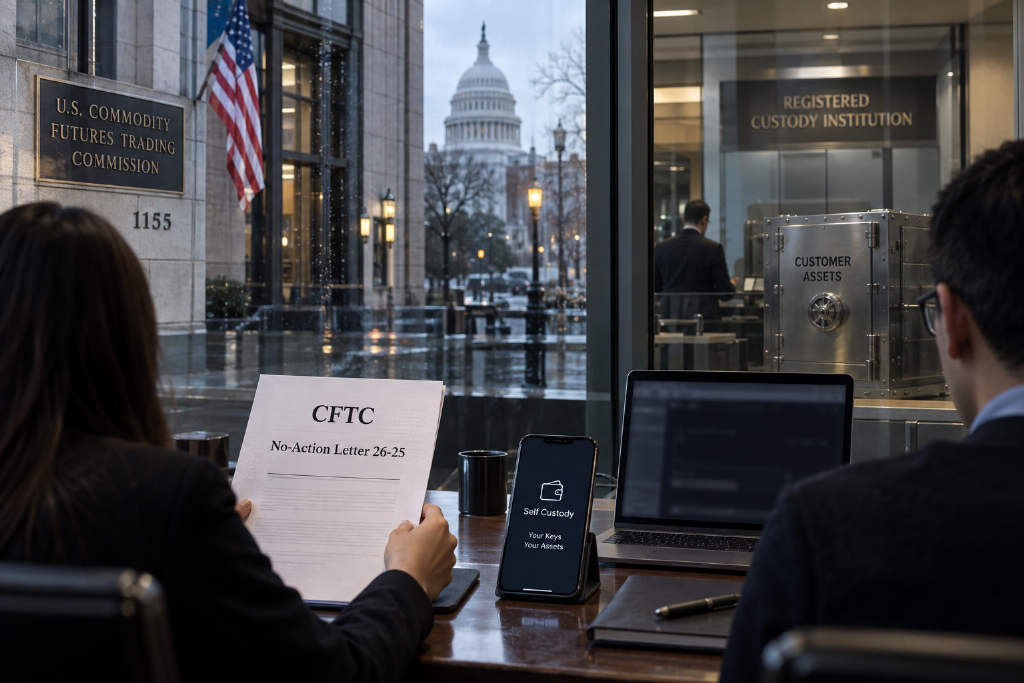
CFTC2026-09-18 02:45:26CFTC’s Letter 26-25 Does Not Ease Crypto Rules and Bars Software Firms From Handling Client AssetsThe U.S. Commodity Futures Trading Commission’s Sept. 17 no-action letter, known as Letter 26-25, has been framed in some coverage as a green light for crypto firms. The text says otherwise. Rather than loosening oversight, the letter limits the circumstances in which a passive software provider can avoid broker registration and ties that relief to the same custody structure used in existing exchange-traded derivatives markets. The letter says covered activity applies only when users trade on a designated contract market, either as members or as customers of a futures commission merchant or introducing broker that is a member. User collateral must stay with the market’s clearing organization or a member futures commission merchant. The software provider cannot hold, control, or custody user assets at any point, cannot generate explicit buy or sell signals, and cannot exercise discretion over order routing or execution. The relief also comes with 10 conditions. The most consequential one requires the software provider and its partner registered entity to sign a written undertaking accepting joint and several liability for legal violations tied to covered activity, while also submitting to CFTC investigative and enforcement jurisdiction. The letter states that it reflects staff views only, does not bind the Commission, and remains in effect only until the Commission adopts effective rulemaking or guidance on how introducing broker registration requirements apply to software developers.400
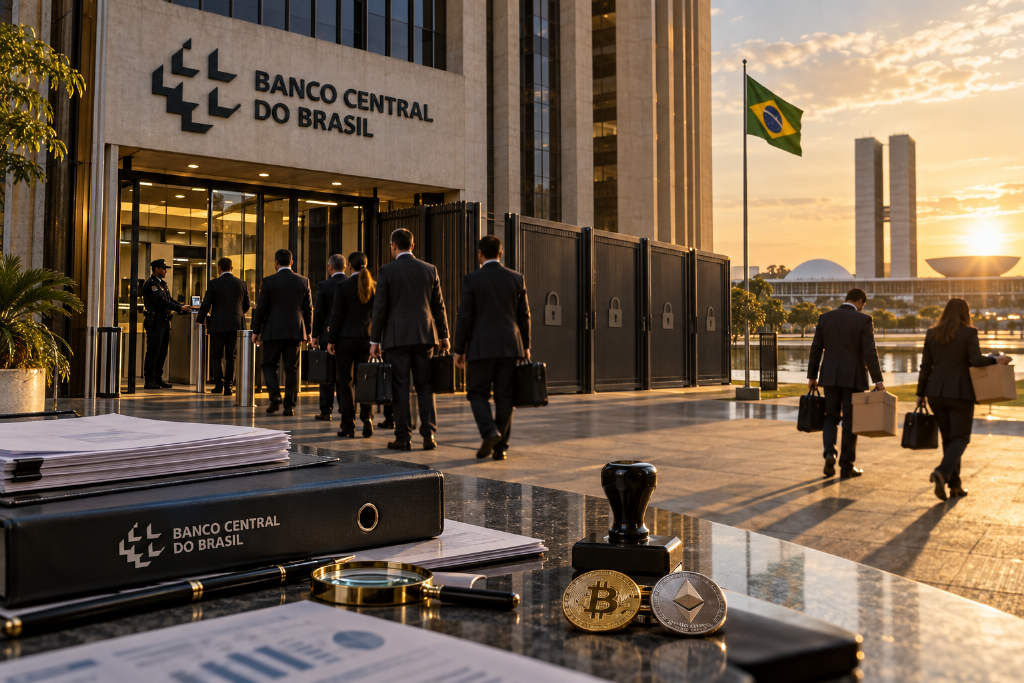
Brazil2026-09-13 09:33:47Brazil central bank rules raise compliance bar for virtual asset service providersBrazil’s central bank has introduced new rules requiring virtual asset service providers to meet compliance standards covering minimum capital, audits, anti-money laundering controls, and ongoing reporting. The maximum capital threshold reaches 37.2 million reais, or about $7.2 million. Of roughly 300 related firms currently operating in the market, only 20 to 25 may be eligible to apply for authorization, and just 10 are expected to secure a license. Some smaller platforms, including Bitnuvem, NovaDAX, Digitra, and Coinext, have already ended or restructured their retail businesses, though they did not attribute those decisions to the new rules. Firms must apply by Oct. 30. Those that do not apply will be required to wind down operations within 30 days and notify customers. Ripple executive Isabel Longhi said market consolidation is likely as Brazil’s crypto market matures, while warning the rules will limit innovation in the short term.860
Policy Regula2026-09-11 09:40:27Fake AML screening sites lure crypto users into wallet approvals that drain fundsA report carried by Foresight and written by Zero Hour Technology warns that a new phishing playbook is exploiting crypto users’ compliance anxiety by posing as anti-money laundering, or AML, screening tools. According to the article, Malwarebytes disclosed on Aug. 19, 2026, that numerous fake AML check sites were actively operating, tricking users into connecting wallets and approving malicious transactions that later emptied their balances. Some pages reportedly impersonated AMLBot, while others used generic branding such as "AML Check," though the report said they were built from the same malicious template. The piece says a legitimate AML screening process is a read-only query that only needs a public wallet address to review on-chain history for links to sanctions, hacks, theft, or suspicious activity. It does not require a wallet connection, a signature, a token approval, or any payment. By contrast, the fake sites simulate a professional workflow with scan progress bars, compliance messages, fake errors, and small "verification fee" prompts before returning a reassuring "Clean, Low Risk" result. The key risk comes after the wallet is connected and the user clicks approve, granting token access that attackers can later use to move funds. The article’s advice is direct: do not connect a wallet for an AML check, do not pay any fee for such a check, and regularly review and revoke unknown token approvals.880
Bitget Wallet2026-09-11 07:52:38Bitget Wallet joins Japan’s BCCC to take part in self-custody wallet compliance talksBitget Wallet said it has officially joined the Blockchain Collaborative Consortium, or BCCC, becoming the first global consumer-facing self-custody wallet to enter the Japanese industry group. The move comes ahead of Japan’s planned implementation of new rules for crypto-asset service intermediary businesses in June 2026. As a BCCC member, Bitget Wallet said it will take part in policy discussions around how self-custody wallets should be defined and positioned within a compliance framework. The company also said it plans to contribute its global operating experience in self-custody wallets to regulatory dialogue in Japan and support broader awareness and use of on-chain everyday finance among Japanese users. Founded in 2016, BCCC describes itself as Japan’s first and largest blockchain industry association. It has more than 270 member companies and runs multiple specialist committees, including groups focused on DeFi and stablecoins. The alliance has long served as a channel for policy communication and coordination between Japan’s blockchain industry and regulators.760